

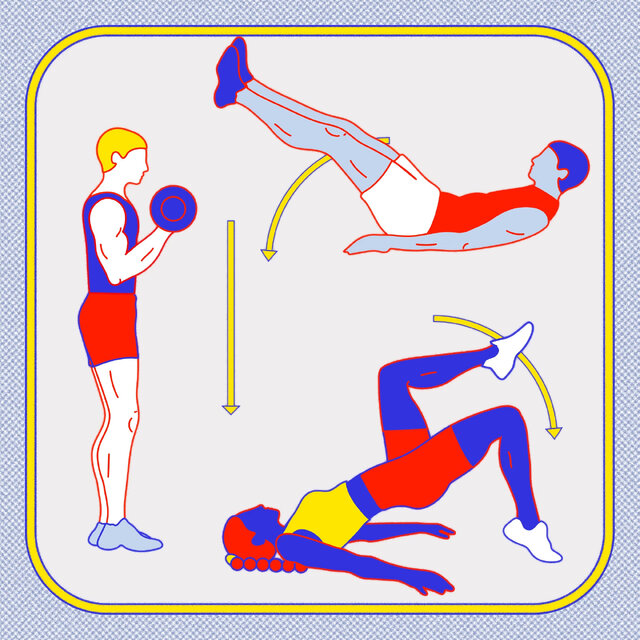
Focusing on eccentric exercises — where muscles extend rather than contract — builds more strength and muscle while also buttressing your tendons.
In the gym, it can be tempting to focus on the showiest moves: the impressive deadlift, an explosive bench press. But to build strength and reduce your injury risk, how much you lift isn’t the only thing that matters. Lowering a weight can do as much — if not more — for your health.
Most movements consist of two phases. During a bicep curl, for example, your muscle shortens as you lift the weight and lengthens as you lower it. But if you don’t spend enough time on the second part — called the eccentric phase — you’re leaving significant strength and muscle gains on the table.
Lowering weight builds strength …
Within a muscle, the action of lowering a weight is fundamentally different from lifting it. For one, it feels easier. That’s partly because you’re working with gravity and partly because connective tissues play a bigger role in lightening the load.
As a result, you need less energy and oxygen to handle the weight, said Brent Pekarski, a physical therapist with University Hospitals Drusinsky Sports Medicine Institute in Ohio. Studies suggest you can lower up to 40 percent more than you can lift.
But don’t be fooled — your muscles are working harder than you may realize during eccentric movements. Christoph Handschin, who studies muscles at the University of Basel in Switzerland, described a workout session he had on an eccentric bike, which forces you to push against pedals that spin backward. “It felt very easy, but the next day, I had sore muscles like crazy,” he said.
That’s because your muscles can produce more force extending than contracting. This makes it easier to progressively overload them, because you can increase the weight or repetitions of your workouts with less effort.