

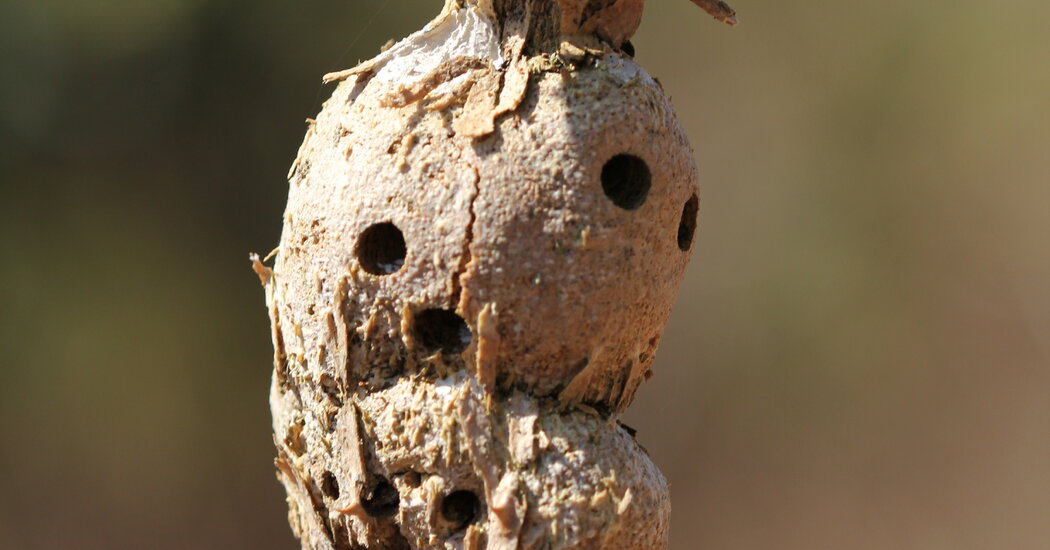
Growths on plants formed by parasitic weevils help their offspring hunker down on a Brazilian savanna and outlast the flames.
Living things have long needed to find ways to survive wildfires. Some of them, researchers recently discovered, can even build their own flameproof panic rooms.
Galls are outgrowths induced on plants by other organisms. In some instances, they form when parasitic insects like midges, moths and wasps release substances that prompt the plant to produce more cells. Galls shelter the larvae of the insects that made them grow, and they protect newborns from predators, parasitoids and adverse weather conditions. It turns out that this perfect nursery can also protect some insect larvae from the flames and heat of wildfires.
The discovery, announced this month in the journal Ecology, came from Jean Carlos Santos, an ecologist at the Federal University of Sergipe in Brazil, who was working in Minas Gerais, a state in the Cerrado, a region of savannas in the heart of the country. At that time, in 2012, “a massive fire erupted in the area,” he recalled, burning for 24 hours.
While walking through the area devastated by the flames, he cut open the galls of Solanum lycocarpum, a common plant living in the Cerrado that is also known as wolf’s fruit. These galls were made by females of the Boheman weevil, which lay their eggs on the wolf fruit’s shoots, inducing thick, multichambered galls that host many larvae.
To his surprise, weevil larvae were still hanging on inside.
“This was both fantastic and intriguing!” Dr. Santos wrote in an email. “I was eager to understand how this was possible.”