

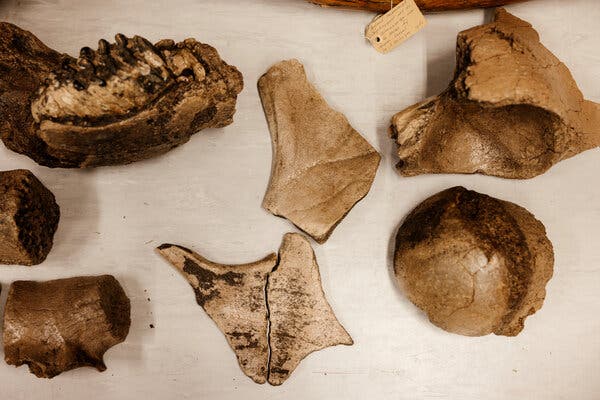
After scouring a beach in the harbor all morning in Rotterdam, the Netherlands, a retired Dutch engineer, Cock van den Berg, had finally found something interesting: a polished black stone about the size of an acorn with two punctures, like finger holes in a bowling ball.
He held it out in the palm of his hand to show Dick Mol, an expert on ice age fossils.
“What do you think?” he asked. “Is it a mammoth tooth?”
Mol examined it for about 30 seconds and decided it was not. It was a molar from a prehistoric rhinoceros, he said.
“It’s from a forest rhino,” he added, dating to “the time that hippos and straight-tusked elephants were living here,” about 126,000 to 116,000 years ago.
Van den Berg is what Dutch scientists like to call a “citizen paleontologist,” one of a cadre of enthusiastic scavengers who come to this 8-square-mile stretch of white sand beach dotted with wind turbines, to hunt for ice age fossils.