

The jigsaw puzzles that Han Li assembles at the Museum of London Archaeology, or M.O.L.A., are as bewildering as a Latin riddle. Mr. Li, a building-material specialist at the institution, has spent much of the year laying out “thousands upon thousands upon thousands” of fragments of painted wall plaster that date to the early Roman occupation of the area around London, which began in A.D. 43.
Mr. Li’s task would confound even jigsaw buffs. The cardboard puzzles familiar from summer camp had straight edges and corners, and you could work from the outside in. The delicate fragments that Mr. Li and his team of conservators are refashioning have irregular edges and form no apparent border.
Pieces are embellished with images of lyres, candelabras, flowers, white cranes and native plants. One is illustrated with the face of a woman in tears, recognizable by her Flavian-period (A.D. 69 to 96) hairstyle.
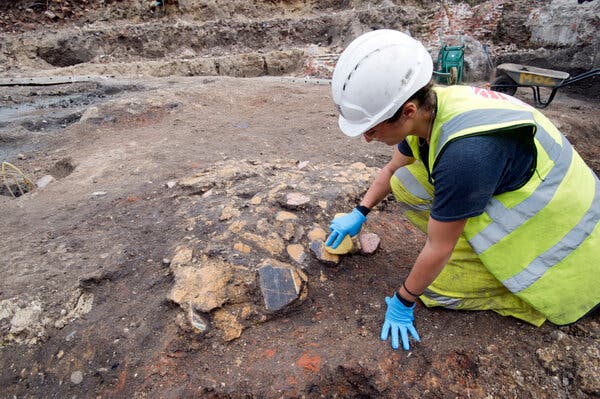
Four years ago, the plaster was recovered during an excavation at a construction site in Southwark, just south of the Thames. The scraps filled 120 assorted boxes. Mr. Li’s job is to carefully arrange, categorize and restore the original artwork. The frescoes that have emerged, the most colossal of which measures 16 feet by 10 feet, were hidden from view for more than 1,800 years.
The museum’s haul of discarded Roman-era plaster is the largest ever amassed in the English capital. Rob Symmons, the curator of the extravagant Fishbourne Roman Palace in West Sussex, called the site “a discovery of the first magnitude.” It is not unusual for painted wall plaster to be recovered from Roman archaeological sites, but rarely is it found in quantities that it was in Southwark, he said: “Also, it’s unusual for excavators to have the time and expertise to attempt reconstructions like the one that Han undertook.”