

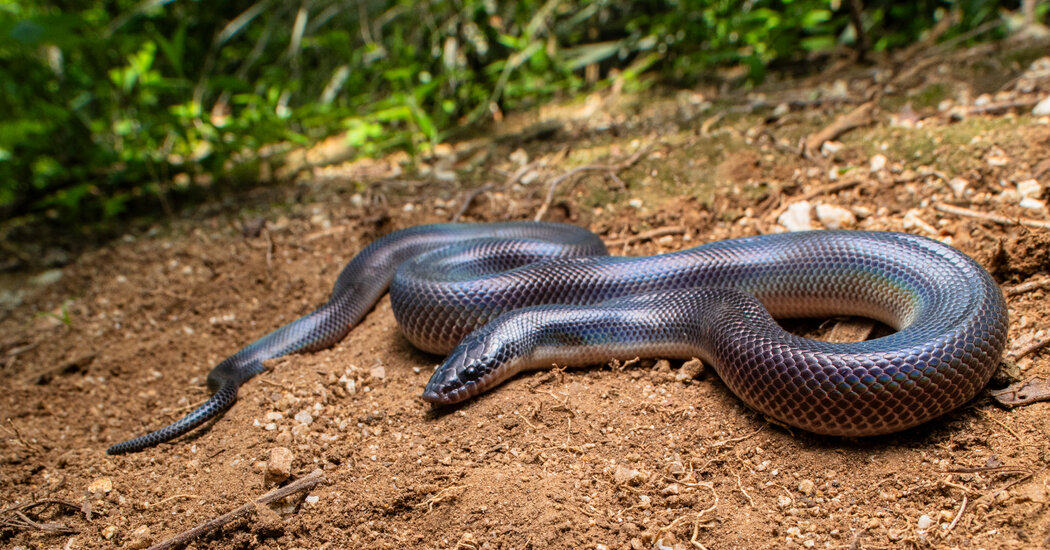
Forget fangs full of venom — the backsides of serpents pack secretions volatile enough to kill insect invaders.
A writhing ball of slimed-up, musky-smelling snake might be just the level of grossness needed to repel the attacks of voracious fire ants.
New research published this spring in The Science of Nature revealed that the scent glands near the back-end of serpents can release enough nasty chemicals to kill ants on touch.
“It’s a remarkable event,” said Robert Vander Meer, a research chemist with the Agricultural Research Service of the U.S. Department of Agriculture.
Previous research had shown that Texas blindsnakes, a largely underground species, might repel ants using the secretions they produce from glands near their cloaca, or the opening from which all snakes defecate. Many snakes will secrete this musk from these glands, located on their undersides, near their tails, rubbing their whole bodies in it.
Dr. Vander Meer and his colleague, Paul Weldon, who was with the Smithsonian Conservation Biology Institute before his death in 2022, wanted to test these observations in the lab.
Dr. Weldon acquired scent-gland secretion samples from several species: the Middle American burrowing python, boa constrictor, ball python, king cobra, timber rattlesnake and unicolor cribo. First they sprayed musk taken from the Middle American burrowing python on ant species, but it didn’t seem to have much effect.