

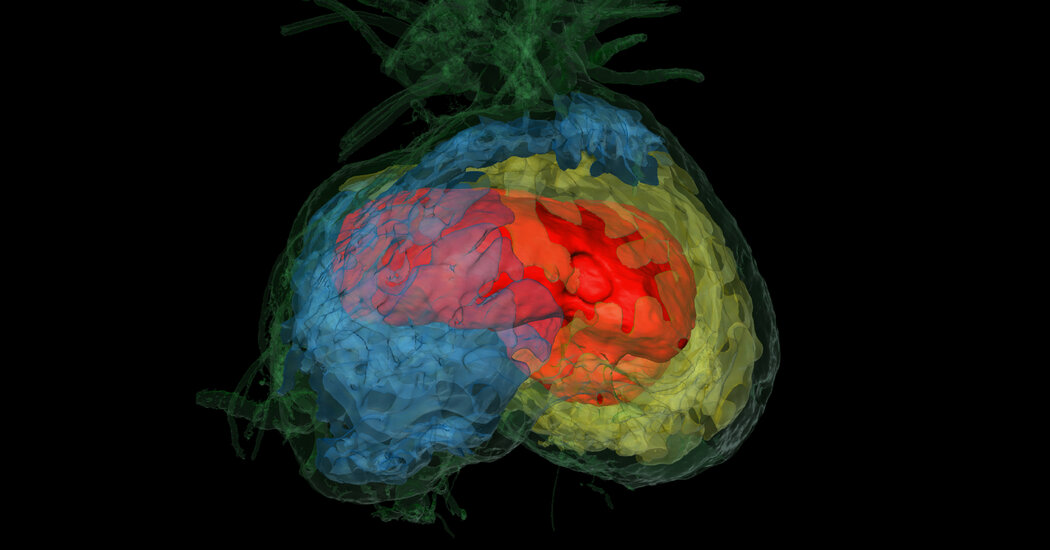
While plants often have mutually beneficial relationships with insects, a tuber in Fiji grows separate compartments for multiple ant species.
On a hot and sticky day in Fiji in 2014, Guillaume Chomicki, an evolutionary biologist at Durham University in England, cut into a tuber the size of a soccer ball with a few leafy branches.
The plant belonged to Squamellaria, a collection of species that grow on trees and are known for housing buckets of ants in what Dr. Chomicki previously showed to be a mutually beneficial relationship.
Each type of Squamellaria specializes in offering a different species of ant a nesting site that’s safe from predators and torrential rains. (In rainforests, there is a glut of ants with a scarcity of lodging options.) The ants, in return, provide crucial nutrients in the form of their feces to the rootless plants. The ants also carry the plants’ seeds to new bark crevices, allowing the next generation to flourish.
As Dr. Chomicki dissected the tuber, expecting to find a single kind of ant, he instead discovered something surprising — two distinct colonies of ants belonging to two different species.
Different groups of ants are notoriously violent toward one another, so Dr. Chomicki was puzzled by how the species could coexist without causing the whole plant-insect enterprise to collapse.
In a paper published Thursday in the journal Science, Dr. Chomicki and his colleagues show that some of these plants manage to serve as careful landlords, creating individual housing for up to five colonies of different species of ants, each within its own separate compartment. This feat of botanical architecture allows the insects to cohabit peacefully, creating abundance for multiple colonies and species within a single tuber.