

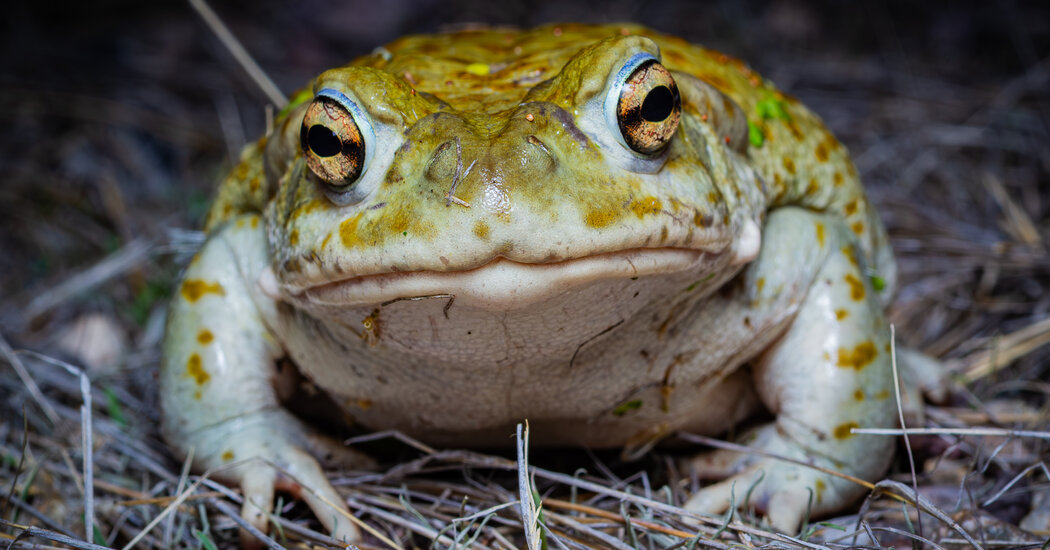
New research suggests Sonoran Desert toads went into steep decline after stories of their mind-bending chemical properties began circulating among drug users.
It looks much like any other toad. It’s plump and green with warty brown spots and vibrant golden eyes. When threatened, though, the Sonoran Desert toad does something extraordinary: It secretes a powerful psychedelic compound from specialized skin glands.
But that potent chemical defense might now be a liability for survival because of a spike in interest in psychedelic drugs.
Trapping in Mexico has decimated several populations of the amphibians and has sent others into steep decline, according to new findings presented at Psychedelic Science, a psychedelics-themed conference held in Denver last month.
“In just over a decade, we’ve put this species at risk of extinction in the name of healing and expansion of consciousness,” said Anny Ortiz, clinical therapeutics lead at the Usona Institute, a nonprofit research organization based in Madison, Wis., that focuses on psychedelic drugs for medical use. Combined with habitat loss and other anthropogenic threats like climate change, “widespread toad abuse” is creating a “triple whammy for the species,” she said.
Scientists chemically identified the psychedelic compound 5-MeO-DMT in Sonoran Desert toad secretions in 1967. But until recently, few people bothered the amphibians or were aware of their psychedelic properties. That changed in 2014, Dr. Ortiz said, when U.S. media outlets and others began publicizing the fact that the toad’s dried secretions could be smoked to induce a brief but intense high.
Many of these accounts also perpetuated a false narrative that “toad medicine” was an ancient practice of Indigenous tribes living in the Sonoran Desert, but no evidence supports this claim, said Dr. Ortiz, who conducted research on the molecule as part of her dissertation at the University of Wisconsin-Madison.