

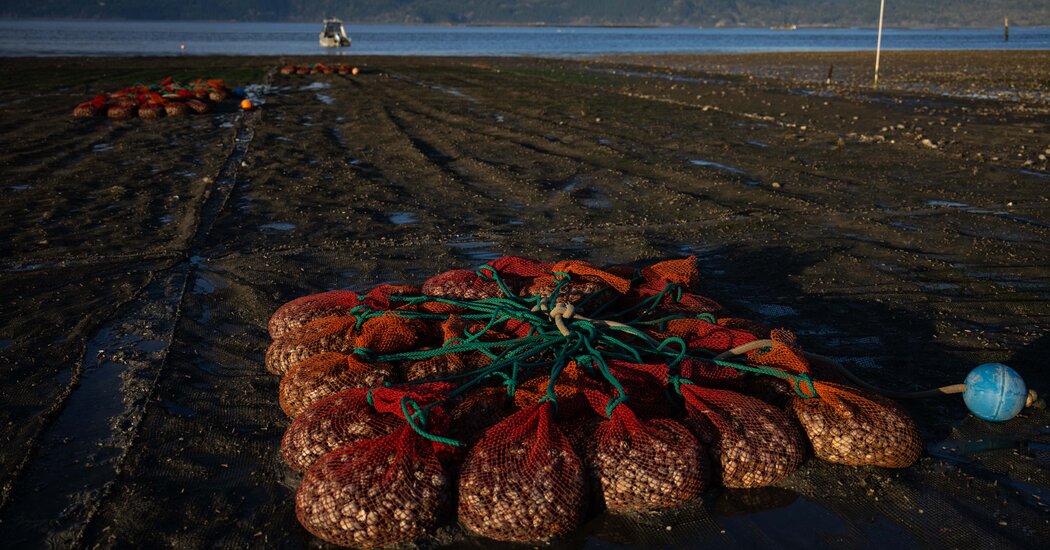
Eighteen years ago, farmed oyster larvae began disappearing in mass die-offs, mystifying hatchery managers in the Pacific Northwest and threatening a thriving part of the region’s economy.
Up to 90 percent of the farmed Pacific oysters — the backbone of the industry — were being wiped out. Businesses like Taylor Shellfish Farms, the country’s largest grower now run by the fifth generation of the Taylor family, stood at the brink of catastrophe.
“It was a crisis, the industry was going to collapse,” said Bill Dewey, a spokesman for Taylor Shellfish Farms based in Shelton, Wash.
The culprit turned out to be an increasingly acidic ocean, and research efforts to solve the mystery have propelled Washington State to the forefront of the world’s efforts to understand and offset the shifting chemical composition of the seas.
Now, the global race against ocean acidification is intensifying as carbon dioxide levels in the seas increase. A recent study found that the world’s oceans crossed a “planetary boundary” in 2020, and warned that things were worse than previously thought. Researchers said the deteriorating conditions could “result in significant declines in suitable habitats for important calcifying species,” including coral reefs and bivalves.
“We are seeing a very significant change in the rate of acidification,” said Dr. Richard Feely, a chemical oceanographer with the National Oceanic and Atmospheric Administration in Seattle who has been studying the problem since it first surfaced, and an author on the recent paper. “The rate of change has shown much faster change over the last 50 years than it did over the previous 200 years. The expectation is, as we continue to release carbon dioxide into the atmosphere, that rate will continue to increase.”