

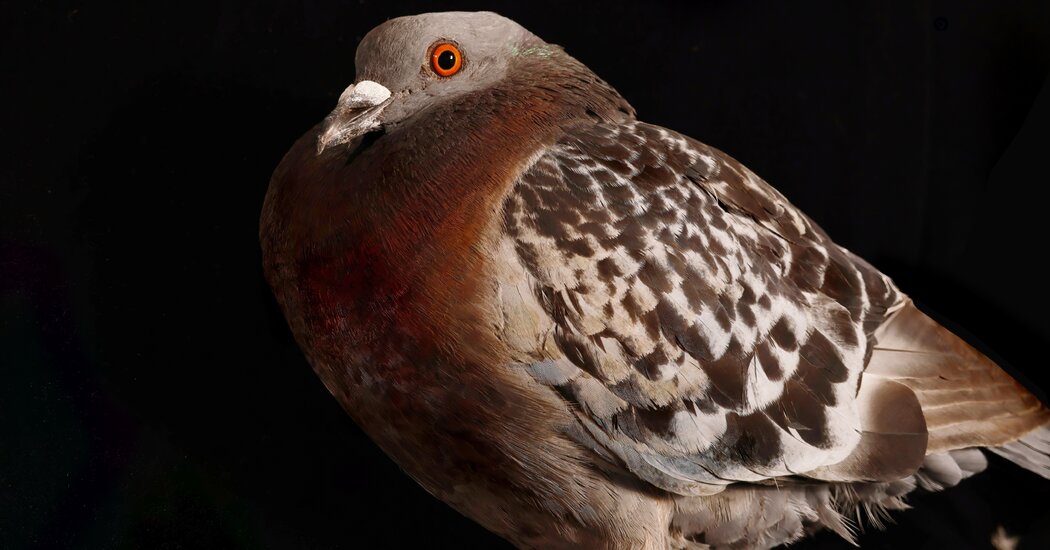
The European wood pigeon helped me appreciate its omnipresent city cousins.
If familiarity breeds contempt, then no wild animal has made itself more loathsome to humanity than the city pigeon. They nest in inconvenient places, overcrowd city squares and corrode stonework with their acidic droppings. One of the first things I noticed when I moved to Berlin 10 years ago was something odd about the pigeons here: Some of them were pretty, far comelier than Manhattan pigeons, who were feral descendants of domesticated rock doves with cigar-stub heads and greaseball breasts. I assumed that the Berlin birds’ handsome white neck patches, soft pink chests and candy-corn beaks were standard traits for Germany’s city pigeons — which meant they were also still messy, diseased and persistent pests.
It was only when I started birding that I realized these more attractive birds weren’t actually city pigeons but a different species entirely called the wood pigeon. Typically forest birds native to Europe and Asia, wood pigeons have rapidly expanded into European cities in recent decades. Many cityfolk probably haven’t noticed the newcomers because they don’t know the differences between city pigeons and their wood-dwelling cousins.
Recognizing the diversity of pigeons is like seeing dispersed light in a rainbow: There are more than 350 species of birds in the family Columbidae, including blue pigeons in Madagascar, pink pigeons in Mauritius, maroon pigeons in São Tomé and metallic pigeons in Indonesia and the Pacific. The green pigeons of Africa and Asia have accents splashed on their emerald base, with yellow-footed, pink-necked and cinnamon-headed varieties. Hike high into the Himalayas or deep into the Australian outback, and you’ll find that pigeons there have adapted to extreme conditions: They inhabit every region of the planet except the poles.
Although pigeons can be as fetching as parrots and nearly as widespread as songbirds, they generally receive far less respect and admiration from birders and scientists. “It appears at first rather surprising that the pigeons are so successful,” the British ornithologist Derek Goodwin once wrote, considering that the small-headed birds often give “the impression of being rather stupid.” The wood pigeon is typical in this regard. In parks, I saw them startle people by exploding out of bushes in a needless panic. In trees, they ventured onto tiny branches that could not support their weight. The males wooed females with courteous fantail bows but blew their chances with impatient, aggressive pecks. A popular bird-watching app described them, in similar language to Goodwin, as “often rather unaware.”
As I read more about the Columbidae, though, I came to appreciate pigeons for more than just their beauty. Their big appetites are crucial to the health of forests around the globe. Researchers observing fig trees in Malaysia once found that green pigeons consumed far more fruit than any other animal in the jungle, visiting some trees more often than all other animals combined. Most animals defecate seeds near the parent tree, but pigeons are long-distance fliers who retain seeds in their guts longer than other frugivores. Pigeons’ ability to fly across oceans is probably why common species of trees grow on the many isolated islands of the Indian and Pacific Oceans. After the Indonesian volcano Krakatoa destroyed all life on nearby islands in 1883, a pigeon was the first frugivore to return. Any seeds in its droppings would have helped regenerate fruit-bearing trees.