

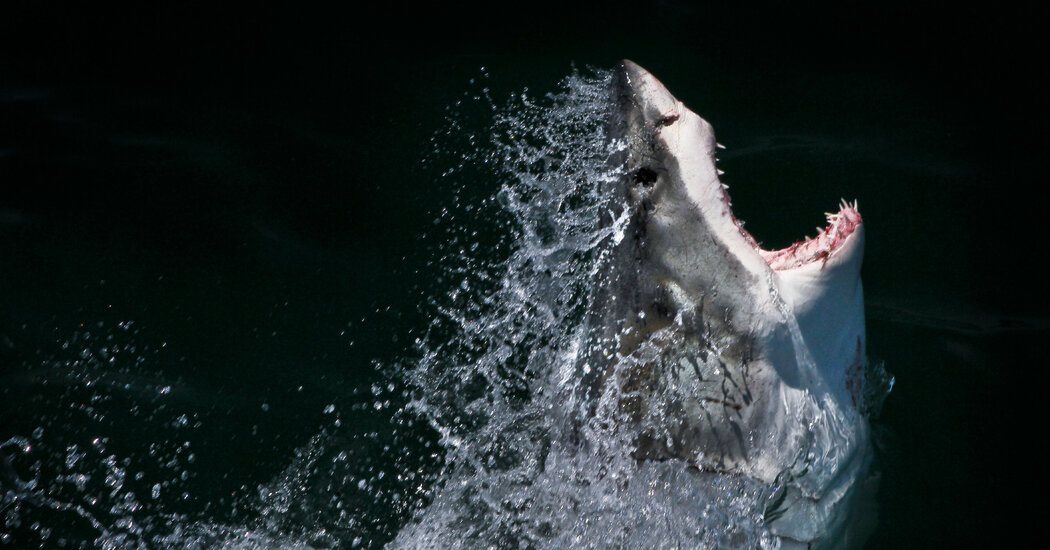
The film’s release in 1975 haunted the reputation of sharks worldwide. But a generation of scientists helped to turn the tide.
When Steven Spielberg’s famous mechanical shark, Bruce, first appeared onscreen in the summer of 1975, Chris Lowe thought it looked fake.
Dr. Lowe, who now leads the Shark Lab at California State Long Beach, was 11 that year. He had grown up on Martha’s Vineyard, the island in Massachusetts where “Jaws” was filmed. He had watched Mr. Spielberg’s crew transform his hometown into “Amity Island.” Some of his schoolmates served as extras; he saw the mechanical shark in person.
But one of the film’s characters in particular captured his attention: the marine biologist Matt Hooper, portrayed by Richard Dreyfuss. Dr. Lowe credited Hooper for first stirring his curiosity about shark scientists. “Hooper kind of got me interested in this idea that there are scientists that get paid to study sharks,” he said.
Dr. Lowe wasn’t the only one.
“Jaws,” the highest-grossing movie of its time, cast a long shadow over the reputation of sharks. Throughout the 1970s and ‘80s, these ocean predators were vilified as voracious monsters and were drastically overfished. The only good shark was a dead shark, the thinking went.
But the film also ushered in an era of curiosity, inquiry and shark science. It produced a generation or more of researchers fascinated with these creatures that remain largely unknown.
“I call it a blessing and a curse,” Dr. Lowe said.
Before “Jaws” premiered in 1975, most shark research was conducted by the U.S. Navy. Much of it involved experimenting and testing repellents to prevent shark attacks on sailors. Very little was known about sharks, and the research sought to understand why they attacked people.