

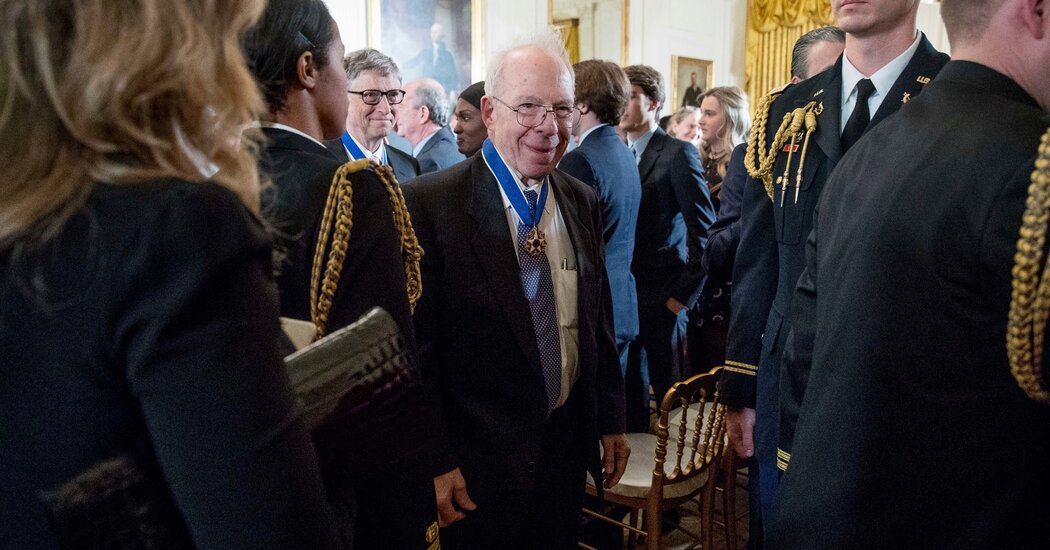
For decades, Richard Garwin fought the apocalyptic bomb he had brought to life.
Times Insider explains who we are and what we do and delivers behind-the-scenes insights into how our journalism comes together.
Once, during an interview, I saw him in action as he described a run of knotty calculations he was doing in his head — the kind of math his peers usually worked out on paper or with computers.
That gift was surely one reason that Enrico Fermi, a founder of the nuclear age who mentored him at the University of Chicago, called Richard L. Garwin “the only true genius I have ever met.” It also played to a popular image of Dr. Garwin as slightly robotic, even computerlike, a thinking machine that happened to have legs.
Dr. Garwin died last month at 97, leaving behind a legacy of contradictions. In 1951, at age 23, he designed the first hydrogen bomb, the world’s deadliest weapon, a planet shaker that could end civilization. He then devoted his life to counteracting the terror.
Over four decades of interviews, chats and social interactions, I learned that the man behind the stereotypes was full of surprises, which I wrote about in a recent article.
He had a reputation for being cruel to those he saw as less talented. That may have been true in the prime of his professional life. But in person during his later years, Dr. Garwin came across as a gentle academic, a humanist whose life turned out to be rich in benevolent acts.
Years ago, Gene Cittadino, a friend of mine who taught science history at New York University, asked me if Dr. Garwin might be willing to speak to his class. After the talk, Gene and several students took him to lunch and were regaled with stories about the presidents he advised. “He was soft-spoken, sharp as a tack and funny,” Gene recalled. The whiz, he added, “treated us with respect,” as if we were his colleagues.