

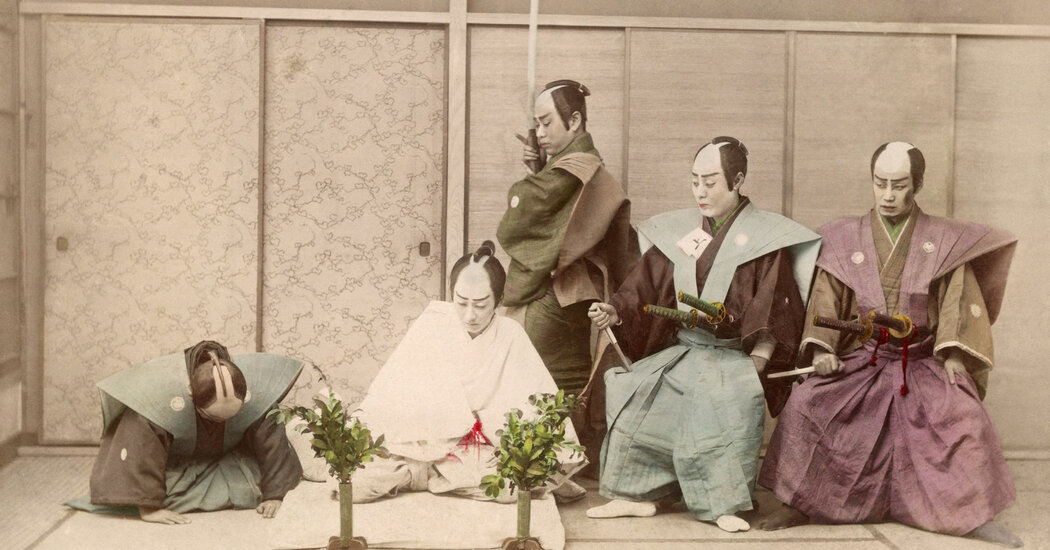
A gory set of manuals, one dating to the 17th century, advised Japanese warriors in the secret ways of seppuku.
In 1970, the celebrated novelist Yukio Mishima committed seppuku, a gruesome form of ritual suicide that originated with Japan’s ancient samurai warrior class. After a failed coup d’état at a military compound in Tokyo, the 45-year-old writer knelt and drew a knife across his belly, cutting laterally from left to right and then upward and downward in a fatal L. Once he had disemboweled himself, Mishima lowered his neck, signaling a trusted second, or kaishaku, who was a member of his private militia, to swiftly behead him with a single stroke of a sword.
But the hands of Mishima’s second trembled so intensely that he botched three attempts, and another follower had to deliver the coup de grâce. Shamed, the kaishaku knelt and stabbed himself in the abdomen, too. Instant decapitation awaits the second who makes a hash of his duties, which is how the most notorious seppuku of modern times ended with two severed heads on the compound’s floor.
“Kaishaku: The Role of the Second” is the title of a new compendium of four rare instructional manuals that have been translated into English for the first time. The earliest, titled “The Inner Secrets of Seppuku,” dates to the 17th century and was originally a work of kirigami, a half sheet of white mulberry paper folded into a book.
“The manuals contain secret teachings that traditionally were only passed along by word of mouth,” said Eric Shahan, who translated the texts. An American-born English teacher based in Japan, Mr. Shahan has a passion for translating ancient martial art books. He came across the two oldest guides, “Inner Secrets” and “Secrets Traditions of Seppuku,” a manual written in 1840, in their original handwritten forms last year in libraries in Japan.
The other two guides detailed kaishaku techniques during the Edo period, from 1603 to 1868. Mr. Shahan came across them in obscure, mid-20th century handbooks on sword-fighting styles.
The compendium answers such questions as what a kaishaku should wear to a beheading (it depends on the social status of the condemned), whether sake should be offered (too much and things can get unruly), and how to properly perform the lop (leave just enough flesh attached for the head to fall naturally forward into the executed man’s arms).