

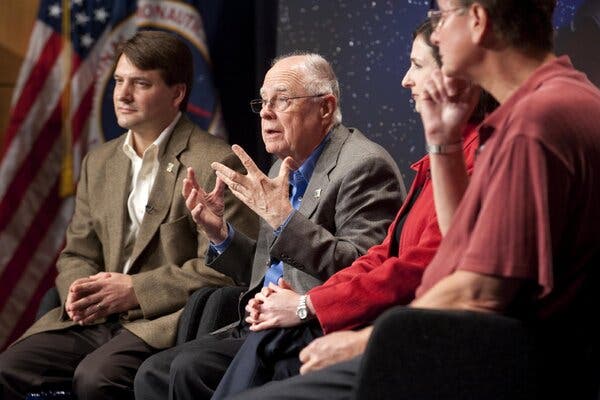
One of the joys of science journalism is in seeing dreams come true — watching scientists push their career chips across the table, on behalf of a vision or a mission that will take years to achieve, and finally win. Their stories are sagas of passion, curiosity and sacrifice.
William Borucki, a space scientist who didn’t have a Ph.D., and his collaborator, David Koch, spent 20 years trying to convince NASA that a space telescope could find planets by detecting their shadows on other stars. NASA rejected their proposal five times until ultimately relenting. “It’s a wonderful thing to have someone tell you over and over again everything that is wrong with your experiment,” Mr. Borucki once said.
He changed the galaxy: The Kepler satellite, launched in 2009, discovered more than 4,000 exoplanets in a small patch of the Milky Way, suggesting that there were as many as 40 billion potentially habitable planets in the Milky Way alone.
Scientists involved in the effort to detect the space-time ripples known as gravitational waves tell a similar story. In the 1970s and 80s, when Rainer Weiss, a physicist at M.I.T., and Kip Thorne of Caltech started talking to the National Science Foundation about the possibility of observing these waves, “everybody thought we were out of our minds,” Dr. Weiss once said.