

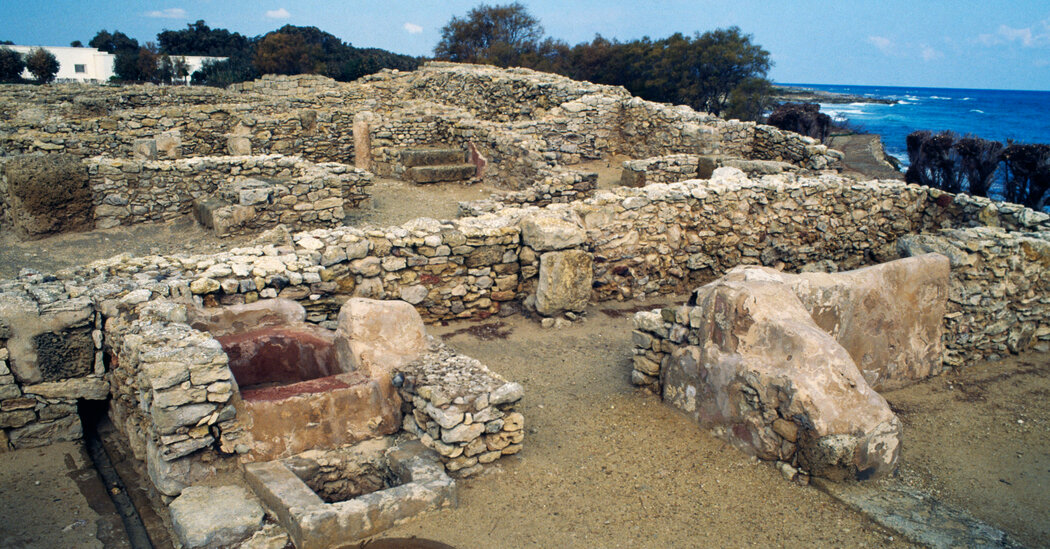
The inhabitants of Carthage were long thought to have derived from Levantine Phoenicians. But an eight-year study suggests they were more closely related to Greeks.
The Phoenicians were a confederation of maritime traders who emerged from the chaos of the Levant about 3,100 years ago and developed the most extensive commercial network in antiquity. Despite their contributions — which included boatbuilding, navigation, town planning and, perhaps most significantly, an alphabet — no literature and few written records survived, beyond funerary inscriptions.
The most powerful and prosperous of the Phoenicians’ independent city-states was Carthage, founded around the ninth century B.C. in what is now Tunisia. The Carthaginians, also known as the Punic people, established an empire that eventually extended across northeastern Africa and into the south of modern-day Spain. Then came the rivalry with Rome and the three Punic Wars, which ended in 146 B.C. after a brutal siege as the Romans razed Carthage, destroyed its libraries and, tradition says, sowed its ground with salt.
For more than 2,000 years, the general assumption was that the Carthaginians derived from the Levant, specifically Canaan, the source of their language and religion. But an eight-year study published on Wednesday in Nature suggests that, from the sixth to the second centuries B.C., Levantine Phoenicians made only a negligible genetic contribution to Punic colonies.
“They preserved Phoenician culture, language, religion and their commercial lifestyle,” said David Reich, a geneticist at Harvard whose lab generated the data, “but passed it to people of biologically different ancestry with whom they mixed after they arrived in these regions.”
An international research team analyzed the degraded DNA from the remains of 210 individuals, including 196 from 14 sites traditionally identified as Phoenician and Punic in the Levant, North Africa, Iberia, Sicily, Sardinia and Ibiza. The study concluded that the Phoenicians did not intermingle equally with all of the people they met. “They had little DNA from Sardinians, Iberians or even North Africans,” Dr. Reich said. Only three of the 103 people whose bones were carbon-dated had substantial Levantine heritage, and those three — one from Sardinia, two from Sicily — may have been immigrants who arrived during the Roman period that followed the Third Punic War.
Overwhelmingly, the main ancestry of the Phoenicians studied was Greek; these were most likely people whom the Phoenicians encountered and mixed with in Sicily, where Greek and Phoenician colonies existed side by side. Dalit Regev, an archaeologist at the Israel Antiquities Authority who collaborated on the paper, said the research showed that the restless mobility of seafaring Aegean men and women and their descendants powered the expansion not only of the Greeks but of the Phoenicians, too.