

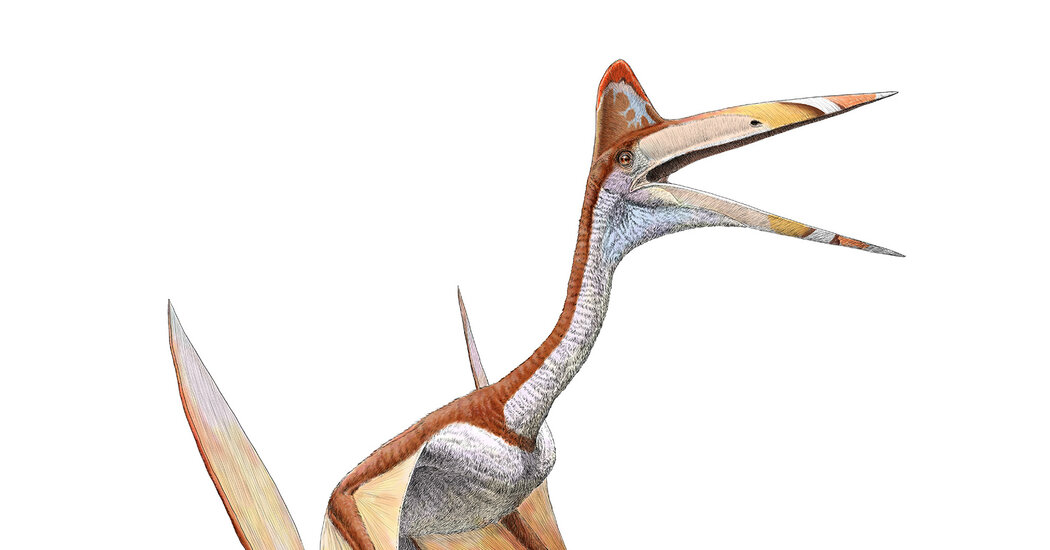
A puncture in the fossilized neck of a winged reptile that flew with the dinosaurs suggests the creature became a feast for a crocodile ancestor.
Around 76 million years ago, something took a bite out of a young pterosaur.
Pterosaurs were large, flying reptiles that roamed our planet’s skies when dinosaurs ruled the Earth. Some species were giants. But even their large size didn’t keep them off the menu.
Paleontologists have discovered a tooth mark in a neck vertebra of a pterosaur that died in what is now Alberta. In a paper published last week in The Journal of Paleontology, they suggest that the tooth mark was made by a prehistoric relative of the crocodile that either snatched the young pterosaur from the shore or scavenged its dead body. The fossil is now on display at the Royal Tyrrell Museum in Drumheller, Alberta.
Pterosaurs came in all shapes and sizes and were found worldwide during their tenure on the planet, which lasted from 220 million to 65 million years ago. But they had fragile bones that were often destroyed before being preserved in the fossil record. Paleontologists mostly find neck and finger bones for this species, and that makes them “quite mysterious,” said David Hone, a paleontologist at Queen Mary University of London who was not involved in the research.
But scientists actually “have a much better idea of what was eating pterosaurs than what they were eating,” said Caleb Brown, a paleontologist and curator at the Royal Tyrrell Museum who was among the authors of the new study. Paleontologists have so far discovered only around four pterosaur fossils that suggest that predators occasionally dined on these winged reptiles — including a neck bone with crocodile-like teeth marks found in Romania and a partly digested long bone in the belly of a velociraptor uncovered in Mongolia.
This latest fossil — a two-inch neck vertebra — was found by students during a dig in 2023 in the Dinosaur Park Formation in the badlands of Alberta. The area is so rich in remains that “you literally can’t walk without stepping on dinosaur bones,” Dr. Brown said.