

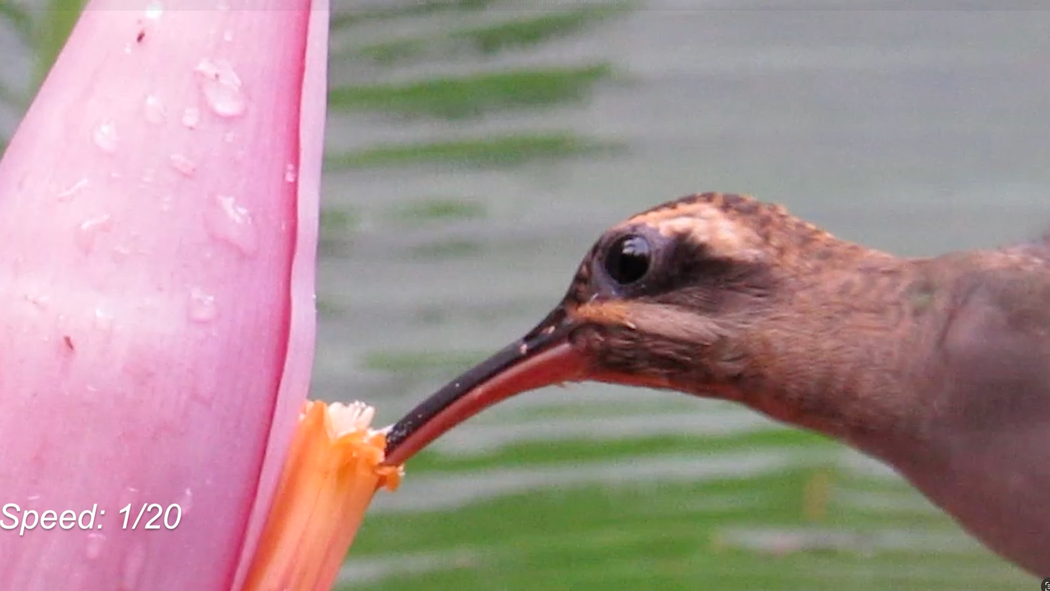
Tiny mites seem capable of relying on the power of static cling to hop into hummingbird nostrils and move between flowers.
Flower mites spend their lives slurping nectar and nibbling pollen in flowers throughout the tropics. To travel from one blossom to another, these tiny, eight-legged creatures hitch rides on the beaks of hummingbirds, taking shelter in the birds’ nostrils during flight.
When a speedy hummingbird arrives at a flower to drink nectar, mites run toward its beak to get onboard before eventually transferring to another blossom. But the poppy-seed-size mites are basically blind and can’t jump, said Carlos Garcia-Robledo, a biologist at the University of Connecticut. How do they sense the bird’s presence and attach to it so quickly?
While doing research at La Selva Biological Station in Costa Rica, Dr. Garcia-Robledo and his colleagues decided to try to answer this question.
In a study published Monday in Proceedings of the National Academy of Sciences, the team discovered that flower mites can sense the same kinds of modulated electric fields that hummingbirds create when their wings rapidly flutter next to a flower. Moreover, these electric fields can also rapidly lift mites across a small air gap.
This is the first time that the ability to sense electric fields has been found in mites, and it suggests that this “electroreception” may be widespread and ecologically important, said Daniel Robert, a biologist at the University of Bristol in England who has published many studies on electroception.
In the study, Dr. Garcia-Robledo and the biologists Diego Dierick and Konstantine Manser devised experiments to assess the mites’ abilities.