

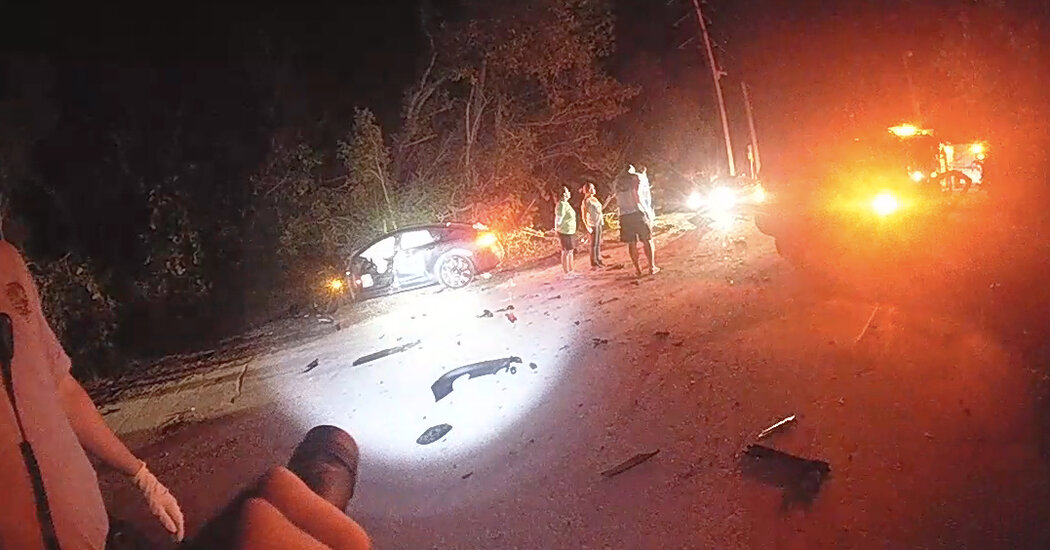
The driver gave testimony in a federal trial about Tesla’s role in a 2019 accident that killed a woman in Florida.
The driver of a Tesla car that killed a woman in 2019 testified in federal court on Monday that the company’s Autopilot driver-assistance system had failed to warn him of an impending accident or engage the brakes.
The driver, George Brian McGee, was driving his new Tesla Model S on a dark, two-lane road in South Florida when his phone fell to the floor and he bent to find it. That’s when he failed to see that the road was ending in a T intersection and that a sport utility vehicle was parked on the other side, with two people standing next to that car.
Neither he nor Autopilot hit the brakes, and the Tesla crashed into the S.U.V. at 62 miles per hour, killing a 22-year-old woman and gravely injuring her boyfriend.
In a civil case in federal court in Miami, Mr. McGee said on the witness stand that he was responsible for keeping his eyes on the road even with Autopilot engaged. But he also said he had been relying on Tesla’s semi-automated driving system to serve as his co-pilot, and thought it had the ability to avoid such a crash.
“I thought it would assist me if I made a mistake,” said Mr. McGee, 48, a partner in a Florida private equity firm. “It didn’t warn me of the car and the individuals and hit the brakes.”
The case, in the U.S. District Court for Southern Florida, was filed by the family of the woman killed in the crash, Naibel Benavides, and her companion, Dillon Angulo. The plaintiffs are seeking unspecified damages from Tesla and aim to convince the jury that Tesla was partly responsible for the crash.