

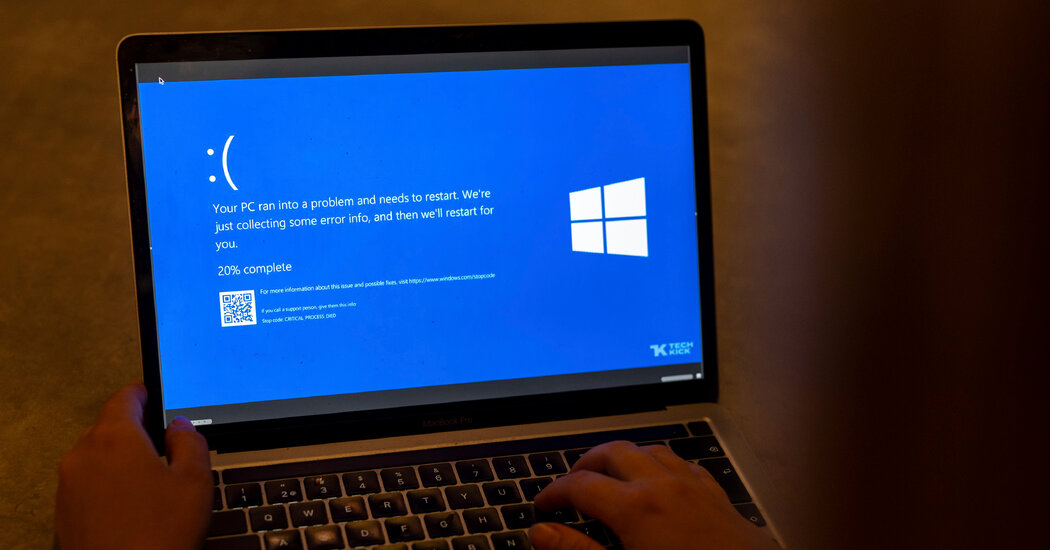
The blue screen that stressed computer users for more than three decades is giving way to a black one.
For millennials, blue can be a significant color. It is associated with clues left by a well-meaning dog in our youth. Songs about a little guy that lives in a blue world (Da Ba Dee Da Ba Di). Or the rage-inducing abject failure of the Windows computer in front of us.
In other words, the Blue Screen of Death.
And now, the world is set to bid a fond farewell to a generation’s most feared and notable error message, as Microsoft announced on Thursday that the screen was being officially replaced by a less friendly but more efficient Black Screen of Death.
The simplified screen, Microsoft said in a blog post, would roll out later this summer, and “improves readability and aligns better with Windows 11 design principles, while preserving the technical information on the screen for when it is needed.” A new message — in white lettering — is slated to say, “Your device ran into a problem and needs to restart.”
For more than three decades, Windows has denoted some sort of serious crash or slow down in its system with a blue screen. An early version of the message was written by the former chief executive, Steve Ballmer, according to Raymond Chen, a longtime Microsoft programmer. The message, released in the early 1990s, would fill the screen: “This Windows application has stopped responding to the system.” Underneath, multiple soothing options were provided over the blue-screen background, including ESC, and ENTER — which would give you false hope that the problem was fixable — and then the last resort “CTRL+ALT+DEL” to give up and start over.
An engineer named John Vert designed one for Windows NT soon after, and Mr. Chen helped finalize a new one for Windows 95 in 1995. All of them were blue by coincidence, according to a blog post by Mr. Chen.
The change to a black screen comes in the wake of last year’s outage generated by the cybersecurity company CrowdStrike. Its software update unintentionally crippled computers using Windows software all around the world, causing disruptions to service for airlines, retail stores and emergency response systems.