

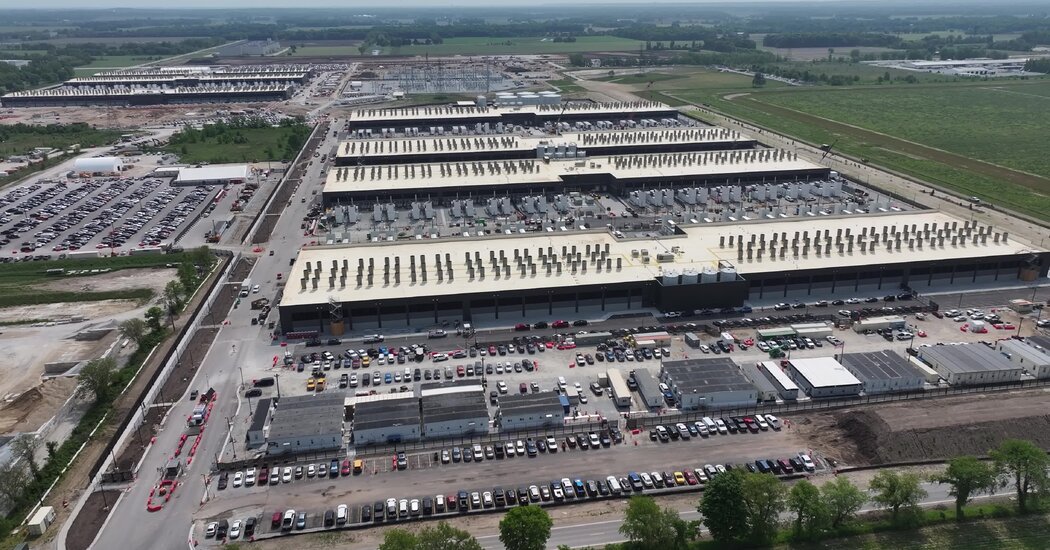
A year ago, a 1,200-acre stretch of farmland outside New Carlisle, Ind., was an empty cornfield. Now, seven Amazon data centers rise up from the rich soil, each larger than a football stadium.
Over the next several years, Amazon plans to build around 30 data centers at the site, packed with hundreds of thousands of specialized computer chips. With hundreds of thousands of miles of fiber connecting every chip and computer together, the entire complex will form one giant machine intended just for artificial intelligence.
The facility will consume 2.2 gigawatts of electricity — enough to power a million homes. Each year, it will use millions of gallons of water to keep the chips from overheating. And it was built with a single customer in mind: the A.I. start-up Anthropic, which aims to create an A.I. system that matches the human brain.
The complex — so large that it can be viewed completely only from high in the sky — is the first in a new generation of data centers being built by Amazon, and part of what the company calls Project Rainier, after the mountain that looms near its Seattle headquarters. Project Rainier will also include facilities in Mississippi and possibly other locations, like North Carolina and Pennsylvania.
Project Rainier is Amazon’s entry into a race by the technology industry to build data centers so large they would have been considered absurd just a few years ago. Meta, which owns Facebook, Instagram and WhatsApp, is building a two-gigawatt data center in Louisiana. OpenAI is erecting a 1.2-gigawatt facility in Texas and another, nearly as large, in the United Arab Emirates.
These data centers will dwarf most of today’s, which were built before OpenAI’s ChatGPT chatbot inspired the A.I. boom in 2022. The tech industry’s increasingly powerful A.I. technologies require massive networks of specialized computer chips — and hundreds of billions of dollars to build the data centers that house those chips. The result: behemoths that stretch the limits of the electrical grid and change the way the world thinks about computers.