

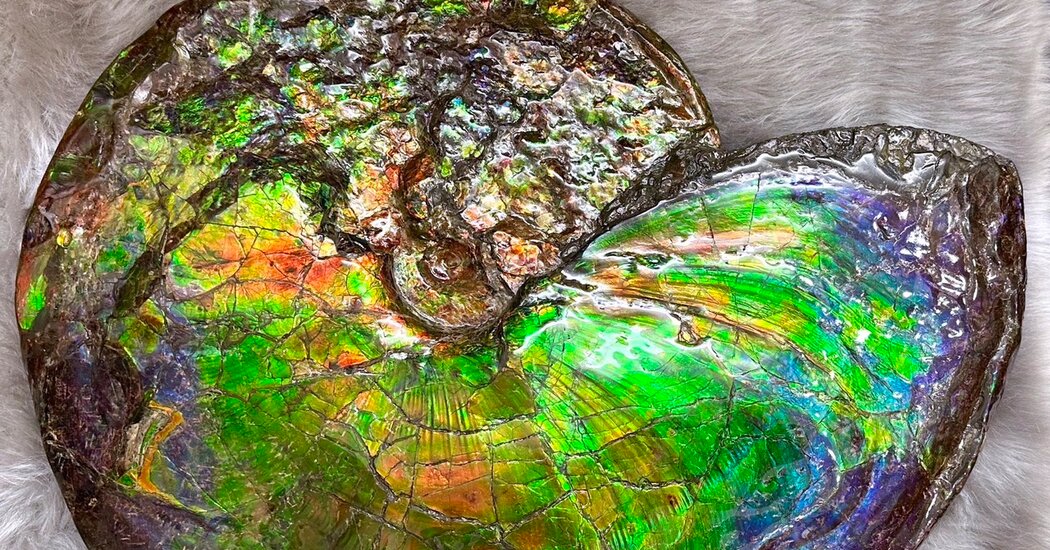
The brilliant iridescent hues found in ammolite come from tiny air gaps in the fossils’ layers, a new study finds.
Millions of years ago, squid-like creatures called ammonites swam through ancient seas. While the animals are long gone, many of their shells fossilized, and some of them formed a rare, prized gemstone that bursts with bright iridescent colors.
The gem is known as an ammolite. While other shells have these colors, some scientists believed that the hues of ammolites seemed more intense.
“The vivid colors of ammolite are an art form created by living organisms and the Earth,” said Hiroaki Imai, a chemist at Keio University in Japan, who was first captivated by the fossils at a mineral fair in Tokyo.
A new study, published last month by Dr. Imai and colleagues in the journal Scientific Reports, showed that inside the ammolite, there are very tiny gaps, about four nanometers wide, filled with air between the plates of the mineral aragonite. These evenly spaced gaps reflect specific colors of light depending on the layer’s thickness, giving ammolite gemstones their brilliant, glowing colors.
“We were thrilled to discover that such an exquisite structure is created through the collaboration of biological and geological processes,” Dr. Imai said.
While ammonite fossils are found all over the world where oceans once existed, most of the fossils that produce the iridescent ammolite are mined along the Bearpaw Formation in Alberta.