

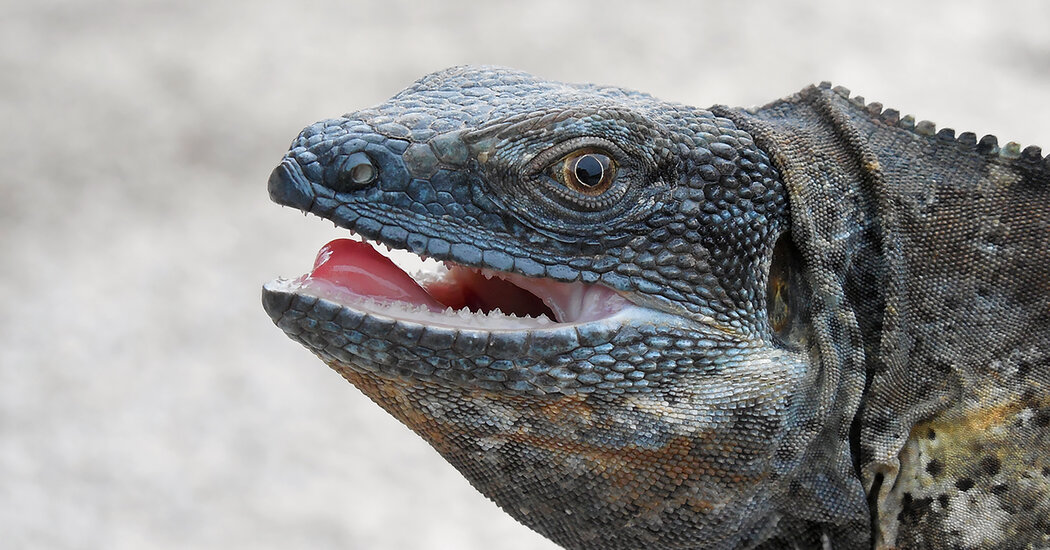
Reptiles on a Mexican island were considered an invasive species, but DNA evidence proves they beat humans to the island by hundreds of thousands of years.
On a Mexican island in the Pacific Ocean, a reptile with seafaring ancestors has been vindicated.
The spiny-tailed iguana has long been assumed to be invasive on Clarion Island. But now, biologists say the lizard actually landed there nearly half a million years ago, long before any humans might have transported them from the mainland. Researchers reported the discovery last month in the journal Ecology and Evolution, and the finding means that the animals should be able to continue living on Clarion Island.
Clarion Island is the westernmost of the Revillagigedo Islands, a remote, mostly uninhabited Mexican archipelago in the Pacific Ocean. There are around 100 iguanas there, and scientists and locals alike assumed that they had arrived in the late 20th century, introduced by humans because they had gone unmentioned in prior accounts of the island’s fauna.
“It was all speculative that they were introduced — no one ever tested it,” said Daniel Mulcahy, an evolutionary biologist at the Museum of Natural History in Berlin who is an author of the new study.
In 2013, Dr. Mulcahy, then at the Smithsonian Institution, visited Clarion to study a rumored snake species. While there, he spotted iguanas and collected some DNA specimens. He noticed the genetic material didn’t quite match that of the spiny-tailed iguanas on the mainland.
A decade later, a colleague called him to say he thought the Clarion iguanas looked different from those on the mainland and were possibly native to the island. The government was planning to exterminate them, thinking they were invasive and harming the island’s delicate ecosystem.
“He was like, ‘We’ve got to tell them don’t do that,’” Dr. Mulcahy said. He decided then to publish his DNA analysis.