

This article is part of our Museums special section about how artists and institutions are adapting to changing times.
What if you could stand in a hallway in a huge building in New York City and feel as if you’re in the center of the universe?
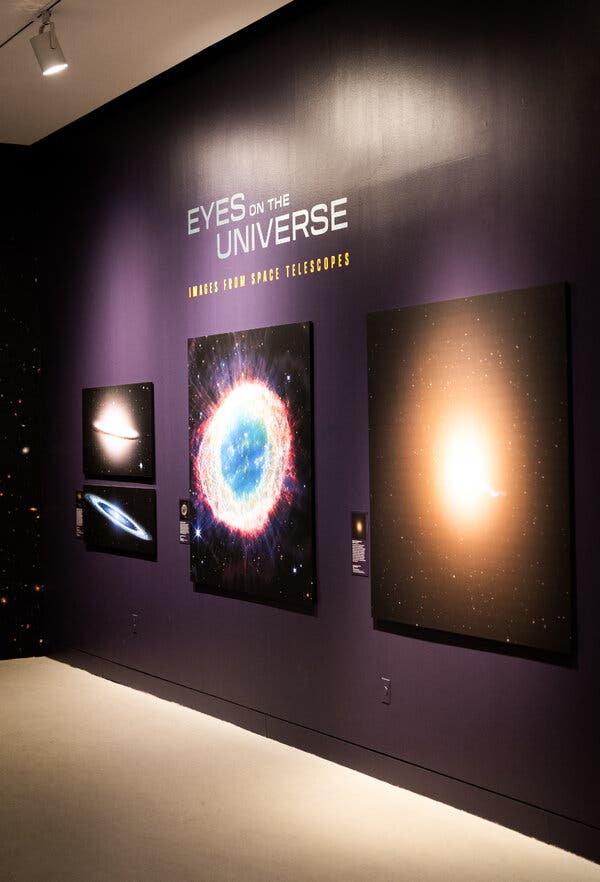
Well, you can. “Eyes on the Universe: Images from Space Telescopes,” at the American Museum of Natural History in Manhattan, is a jewel box exhibition of 14 photographs of supernovas, planets, galaxies and other astrophysical objects captured by three telescopes operating in space. It opened earlier this year and will run indefinitely.
It couldn’t be more timely. When two NASA astronauts splashed down in March after unexpectedly spending nine months — instead of one week — on the International Space Station, the public was transfixed.
And with the growth of private space companies, space tourism might be within reach, at least for the ultrawealthy.
The introductory photograph just outside the exhibition — more than five feet across —- shows a visualization of data from the Milky Way galaxy that looks something like a wispy outline of a mountain range illuminated in the dark. It was taken by the Gaia telescope, which was launched in 2013 by the European Space Agency and completed its mission in March.