

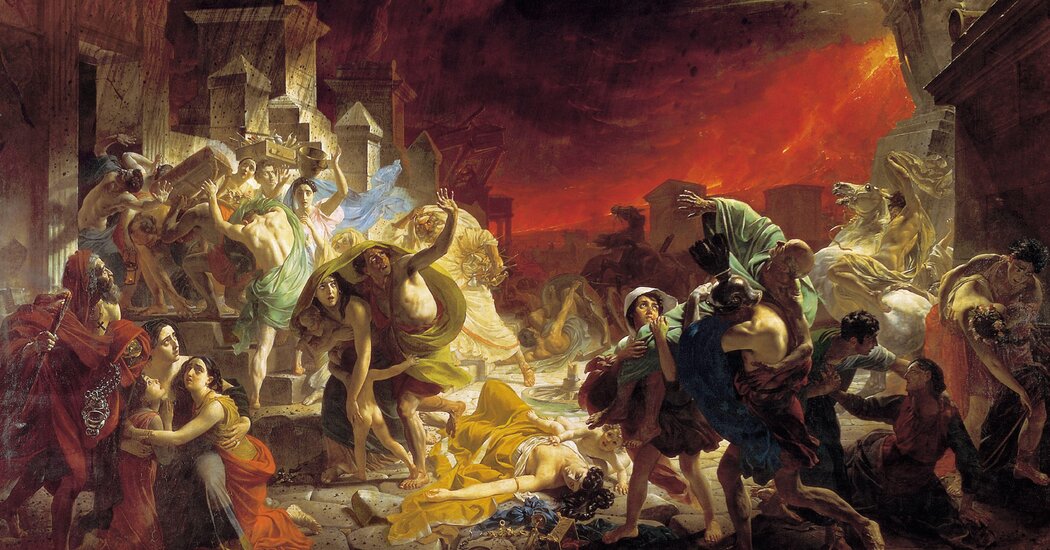
When Mount Vesuvius erupted in A.D. 79, fiery avalanches of ash and pumice assaulted Pompeii, displacing some 15,000 inhabitants and killing at least 1,500 more. Volcanic debris “poured across the land,” wrote the Roman lawyer Pliny the Younger, and blanketed the town in a darkness “like the black of closed and unlighted rooms.” Within two days Pompeii had vanished, leaving little more than a legend until 1748, when the chance discovery of a water line prompted the first deliberate excavation.
In his late-18th-century travelogue “Italian Journey,” Goethe observed that no calamity in history had given greater entertainment to posterity than the eruption that had buried Pompeii. For scholars and armchair archaeologists, that entertainment has involved wrangling over pretty much every facet of the disaster. They still can’t agree on the day Vesuvius blew its top, the height of the umbrella-shaped cloud or the length and the aggression of the blasts. Two new research projects add kindling to those embers.
A report published by the Archaeological Park of Pompeii resurrected the once widely accepted belief that the cataclysm began to unfold on Aug. 24, the date put forward by Pliny, who was 17 when he witnessed the event from a villa across the Bay of Naples. His letters to the historian Tacitus, written more than 25 years after the fact, are the only surviving firsthand account and the only documents that offer a precise date.
We no longer have the original letters, only translations and transcriptions of copies, the first of which was made in the fifth century A.D. “Many manuscripts of Pliny’s letters came down to us with differing dates,” said the classicist Daisy Dunn. Her 2019 biography of Pliny, “The Shadow of Vesuvius,” is the definitive guide to him and his uncle, the naturalist Pliny the Elder, who died during the eruption. “Aug. 24 was chosen as the most secure on textual grounds,” Dr. Dunn said.
In sticking by Pliny, the park walked back some of the recent enthusiasm for Oct. 24 as a possible start date for the eruption, a theory that had been fueled by the 2018 discovery of a scrap of graffiti on a wall of the site’s freshly excavated House of the Garden. The charcoal scrawl records a date that translates to Oct. 17 in the modern calendar, suggesting that the eruption might have occurred after this time. The find, which did not specify a year, seemed to corroborate other unearthed clues that pointed to cooler weather than is typical in August: remnants of unripe autumnal fruits such as chestnuts and pomegranates; heavy wool clothing found on bodies; wine in sealed jars, indicating that the grape harvest was over; and wood-burning braziers in homes.