

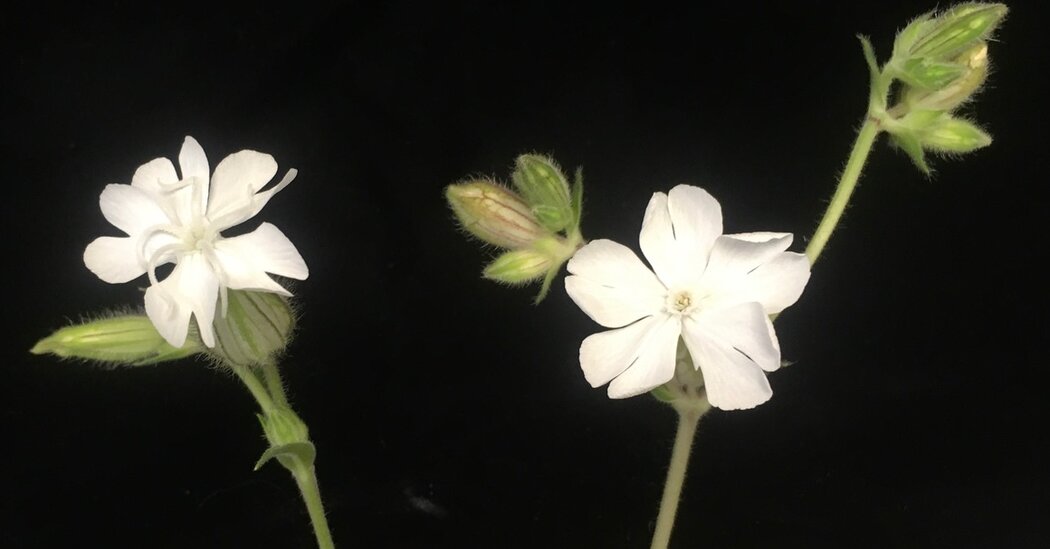
Scientists published a full genetic sequence of the genes that make some white campions male, and hope their work could unlock how the flower got that way.
The vast majority of plants are hermaphrodites, with both male and female reproductive parts. Oaks, some orchids, the potted spider plant in your office — they’re all capable of reproducing without a member of another sex nearby.
“It makes sense if you are an organism that can’t run around and find mates,” said Deborah Charlesworth, a population geneticist at the University of Edinburgh who has studied the reproductive strategies of plants for decades.
But some plants have taken a different approach. They have evolved sex chromosomes, the bits of DNA that make individual plants either male or female. In that club are organisms like the ginkgo, whose females produce stinky fruits, while males are stink-free. Or consider the asparagus, whose females produce red berries and thinner stalks than males.
Some of these species are stranger yet: Their sex chromosomes are bizarrely outsized. The diminutive white campion plant, for instance, packs a Y chromosome that is bigger than the entire genome of the puffer fish or that of the fruit fly. In the journal Science on Thursday, collaborating researchers, including Dr. Charlesworth, have published a full sequence of the white campion’s beefy Y chromosome, allowing a closer look at its contents and evolutionary history.
DNA sequencing is commonplace these days. But in the 1990s, when fast sequencing technology was new and fueling a revolution in biology, scientists could not use it effectively on the Y chromosomes of plants, said Gabriel Marais, a biologist at Université Claude Bernard Lyon 1 in France and a senior author of the new paper.
That’s because the techniques used to sequence the rest of the genome do not work well on Y chromosomes, which tend to have many of the same sequences repeated over and over. Slicing up the Y chromosome, sequencing the fragments and trying to piece them together like a puzzle — which works so well with the rest of the genome — yields so many identical pieces that it is impossible to assemble the larger picture.