

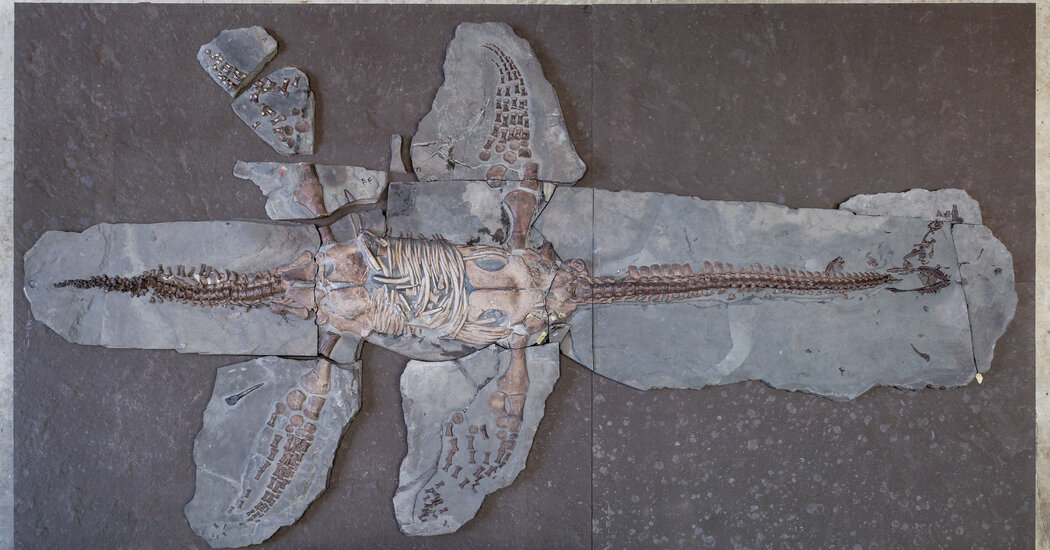
With serpentine necks, flippers and a mouth full of needle-sharp teeth, plesiosaurs have captured imaginations since paleontologists uncovered the first specimen more than two centuries ago. Their skeletal anatomy is well documented, but their external appearance has largely remained a mystery.
Now researchers have conducted the first detailed analysis of plesiosaur soft tissue, offering a more complete look at what these real-life sea monsters might have looked like when they lived from 215 million to 66 million years ago.
Published Thursday in Current Biology, the findings suggest that some plesiosaurs had humanlike skin on their tail regions and fishy scales on their flippers, similar to the features of some living sea turtle species. The research highlights an evolutionary detour that runs counter to other ancient marine reptiles like ichthyosaurs and mosasaurs, which evolved away from scales in favor of skin, or much smaller scales, to allow them to move more efficiently through their marine habitats.
“These are iconic animals, and the way we reconstruct them hasn’t changed for nearly 200 years, so this is a big update,” said Miguel Marx, a doctoral student at Lund University in Sweden and lead author of the paper. “It changes our perspective on their evolutionary history and how they adapted to life in the ocean.”
Mr. Marx and colleagues analyzed three soft-tissue skin samples, each about the size of a fingernail, from a flipper and the tail of a 183 million-year-old long-necked plesiosaur specimen. The species is to be named in a future peer-reviewed paper. But the samples came from the Posidonia Shale in Germany, where the ocean chemistry preserved soft tissues. That left it frozen in time. Some of the tissue remains were so flawlessly fossilized that researchers could see skin cell nuclei under the microscope.