

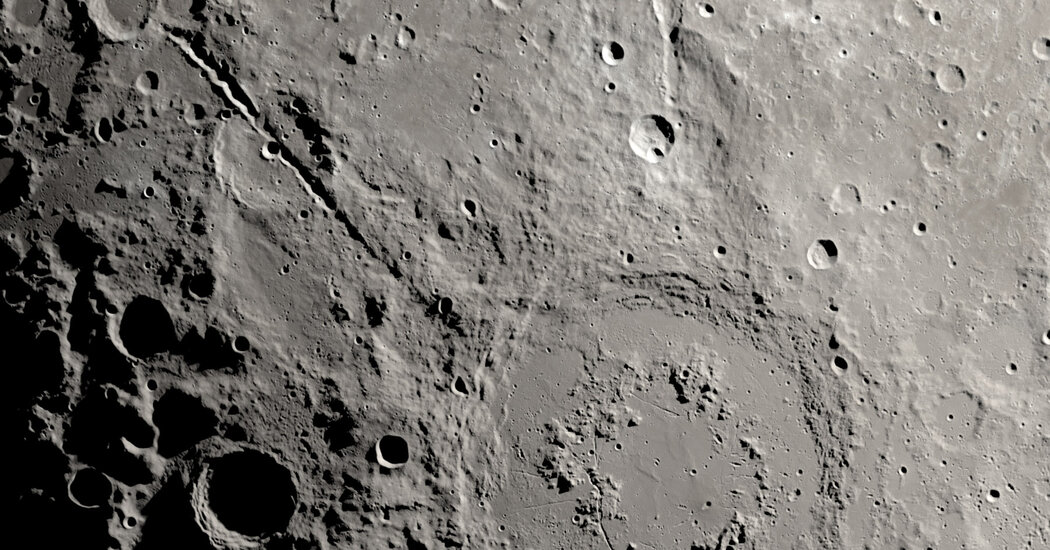
Scientists proposed an explanation for the formation of Vallis Schrödinger and Vallis Planck near the lunar south pole, which are each about the size of Earth’s Grand Canyon.
Two canyons near the south pole of the moon rival the Grand Canyon, both in depth and length.
Unlike the sinuous chasm in Arizona, the two lunar canyons, known as Vallis Schrödinger and Vallis Planck, are straight, as if the crust of the moon had been cut by a knife.
And unlike the Grand Canyon, carved over millions of years by the flow of the Colorado River, Vallis Schrödinger and Vallis Planck formed in just minutes after a 15-mile-wide meteor struck the moon some 3.8 billion years ago.
Indeed, carving these vast lunar trenches took less time than it might take you to bake a frozen pizza.
The impact, comparable to the one that smashed into the Earth 66 million years ago and killed the dinosaurs, punched up to 15 miles into the crust and excavated a crater about 200 miles wide. In the process, it ejected fusillades of giant rocks — what planetary scientists call ejecta rays — that crashed down in staccato succession to create the canyons, which are more than 1.5 miles deep and more than 165 miles long.
“They truly are extraordinary in scale,” said David Kring, a scientist at the Lunar and Planetary Institute in Houston. “These things were carved in less than 10 minutes when the Grand Canyon took 5 to 6 million years to carve. I mean that illustrates the energy of an impact event.”
In a new analysis, Dr. Kring and his colleagues, Danielle Kallenborn and Gareth Collins of Imperial College London, constructed a mathematical model to describe how the canyons formed in a rain of giant rocks. They used photographs taken by NASA’s Lunar Reconnaissance Orbiter, which showed a string of craters along the canyons, to calculate the speed and direction of the debris.